
I dont know much about juvie K. hibernalis but the carapace on this one is quite rounded and has no depression in the middle. Cheiracanthium inclusum the Yellow Sac Spider perhaps?
Ok i went to rehouse one of my P. muticus females earlier, and found this little guy in the substrate of the new home. It looks like a young K. hibernalis. Im hoping it is. I wouldnt figure they are this far north (Ohio), but i have family from NC here right now, and thought maybe it hitchhiked along. But then it would have to travel upstairs to my T room, and then climb up a dresser, and then get into the enclosure. Not saying that isnt totally possible, but seemed odd. Its fangs do look forward pointing like a tarantula's. I couldnt get a great look at them though because the little guy was lightning fast and wouldnt hold still much. The abdomen is grayish silk looking. Its about 1" long. Any ideas? Thanks for any help.
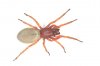
I dont know much about juvie K. hibernalis but the carapace on this one is quite rounded and has no depression in the middle. Cheiracanthium inclusum the Yellow Sac Spider perhaps?
All my freaks come out at night
Well all the pics i seen of C. inclusum dont really match mine. They are mostly yellow, and the spider i found has a reddish carapace and legs, and a greyish abdomen.
Last fall I found one that looked like this one and we identified it as a Dysdera crocata, at least that's what it looked like according to national wildlife federation insects aand spider. Field guide.
dysdera crocata
Not going to be a D. crocata carapace/fangs etc don't mach plus they usualy have minimal hair, his has hair.
Whats ur guess, I live in ohio also and have seen similar
I've seen similiar, however, I do not recall/not confident with the family to gie a guess, but I am going through my google prowess![]()
let us know
Well i took a closer look at it, and it has the little dimples on the abdomen like the K. hibernalis. But im not sure what all species have those dimples. And i gave it a small cricket, and it immediately took it. I tried to watch the fangs, they are small, but did look like they were forward pointing. Also its almost impossible to tell in that ventral shot, but it has 1 set of booklungs.
Hi, guys. It is definitely not a Kukulcania hibernalis, nor is it an Dysdera crocata. It is a ground-dwelling spider, but alas, the name eludes me.... :-(
Originally Posted by Insektzuchen
Originally Posted by zonbonzovi
Hey man i was just getting ready to pm you, and seen your last post was on this thread. Thanks. I have looked through bugguide, but as you know identifying native true spiders is hard. When i first seen it, i thought Hacklemesh weaver, until i got a closer look. This thing is almost as fast as my huntsman.
http://bugguide.net/node/view/611471/bgimage
One in the Clubiona family could be a guess, but with only an underside look at the chelicera and being unfimiliar with the taxo of these families I can't say.
I've found spiders of similiar shape and colour, often the hairs of the abdomen look almost metallic; I find them under rocks or in rolled up leaves that they turn into a home, But alas. Thats about all I know and the ones I find are similiar not identicle :/
This is a Gnaphosid spider, probably in the Gnaphosa genus; the long spinnerettes are a dead give-away. These are very common indoor spiders pretty much all over North America. They DO look a bit like mini tarantula, especially with those long spinnerettes and forward-facing chelicerae, but are "true" spiders. K.hibernalis does not have visible spinnerettes when seen from above, and they aren't that fast, either.
pitbulllady
Thanks pitbulllady. I tried looking through bugguide again under the Gnaphosa genus, and there were a few that looked like it, but cant be positive. Here is a quick link to the Gnaphosa genus. http://bugguide.net/node/view/1970/bgpage
There are currently 1 users browsing this thread. (0 members and 1 guests)
Bookmarks